A stabilizer selected from a nominal 230 V or 415 V assumption can fail when motors start, phases become unbalanced, or the incoming supply moves outside its correction window. You will learn how to measure the site, calculate the kVA, compare supplier documents, prepare the electrical room, and commission the equipment safely.
Key takeaways
- Record terminal voltage during normal and peak operating periods.
- Calculate stabilizer kVA from actual connected and starting loads.
- Match the stabilizer type to voltage variation, phase imbalance, and load sensitivity.
- Confirm documents, installation scope, testing, and handover obligations before ordering.
Measure the Supply and Calculate the Required kVA Before Requesting a Quote
A nominal 230 V or 415 V label is not enough for a quotation. If you are researching a voltage stabilizer supplier for selection installation process in new delhi, record the actual supply at the equipment terminals during normal operation and peak activity.
- Measure phase-to-neutral and phase-to-phase voltage, including minimum and maximum readings, phase imbalance, frequency, neutral displacement, and major voltage dips during motor starts or transformer energisation.
- List every load with running kW or kVA, power factor, phase arrangement, and duty cycle. Separate motors, compressors, welders, rectifiers, variable-frequency drives, UPS systems, and transformers because starting current, inrush, and harmonic current change the required capacity.
- Calculate running kVA, then check the largest starting or inrush event. Request a continuous stabilizer rating that covers both, rather than sizing from the nameplate total alone.
- State the required output voltage and tolerance, not just “stable voltage.” Ask each voltage stabilizer supplier to quote input range, output accuracy, correction rate, response time, and load conditions together; accuracy outside the declared input range is not a valid comparison.
- Describe the room: dust, seasonal heat, humidity, rooftop exposure, ventilation, water-ingress risk, cable route, and maintenance access. Request the rated ambient temperature, altitude limit, enclosure IP rating, derating, and filtered or forced-ventilation requirement.
Include the upstream breaker rating, earthing arrangement, neutral identification, phase sequence, and whether a bypass or isolation point is required. Send the measurement log and load schedule with the request, not after the supplier has selected a model.
Match the Stabilizer Type and Specifications to the Fault You Actually Have
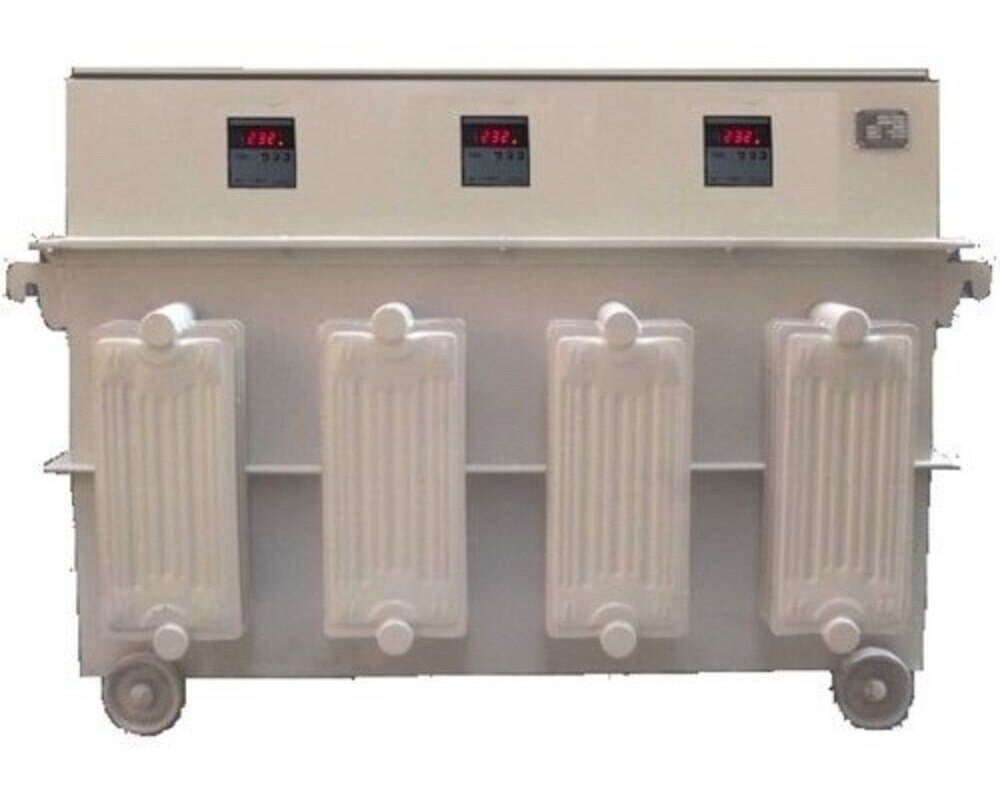
Choose the correction technology from the failure, not from a nominal 230 V or 415 V label. A servo stabilizer suits slow, sustained voltage variation; it does not replace backup power or cure frequency instability, harmonics, poor power factor, or a defective neutral.
| Technology | Best fit | Limitation to test |
|---|---|---|
| Servo stabilizer | Wide, gradual input variation on motor loads | Correction speed, brush life, overload curve, and starting kVA |
| Static voltage regulator | Fast correction for sensitive electronic equipment | Output capacity, waveform distortion, and bypass behaviour |
| Tap-changing or booster transformer | Defined voltage steps and high continuous loads | Step size, switching delay, isolation, and short-circuit rating |
| UPS | Voltage correction plus outage protection | Battery autonomy, inverter kVA, overload time, and frequency output |
Ask an industrial voltage stabilizer supplier for separate continuous-load and transient calculations. A unit that carries running kVA can still trip when a compressor, pump, elevator, HVAC motor, transformer, welder, VFD, UPS, or rectifier starts.
Compare input range, output tolerance, response time, correction rate in volts per second, efficiency, power factor, waveform distortion, overload capacity, and protection trips together; accuracy has meaning only within the stated range and load.
For three-phase equipment, specify three-wire or four-wire construction, neutral continuity, and whether regulation is common or independent by phase. The quotation must state phase-imbalance handling, input/output limits, bypass arrangement, and meter accuracy. Reject “high accuracy” without test conditions, an overload curve, and a test certificate.
Wider input range can mean slower correction or reduced output capacity.
Check the Supplier’s Documents, Scope and Quotation Line by Line
A quotation is comparable only when it states what is supplied, installed, tested and excluded. Reject “complete package” wording unless the voltage stabilizer supplier identifies the rated kVA, phase arrangement, input range, output tolerance, correction rate, response time and load conditions behind each figure.
Ask for these items in writing:
- Test certificate, routine-test standards and the exact model number
- Single-line and wiring diagrams, neutral arrangement, bypass circuit and phase-wise regulation
- General-arrangement drawing, dimensions, cable-entry points, foundation details and lifting requirements
- Protection settings for overvoltage, undervoltage, overload, short circuit and thermal trips
- Rated ambient temperature, allowable altitude, enclosure IP rating, derating, ventilation and filter requirements
- Installation scope covering transport, unloading, positioning, cable glands, lugs, terminations, earthing, testing and commissioning
- Output meters, alarms, spare parts, preventive-maintenance intervals and response to failed servo components
- Warranty period, exclusions, travel charges, downtime responsibility and the price of recommended spares
Compare accuracy, input range and correction speed together. An accuracy figure such as ±1% is incomplete without the input range and load at which it applies; a wider range can reduce output capacity or slow correction.
The quotation must also state whether it covers only regulation or includes a UPS, generator interface, surge protection, harmonic filtering or ride-through. A servo stabilizer does not maintain power during an outage.
Give Sneh Raman Electricals Pvt Ltd the same document checklist as every competing voltage stabilizer supplier, so a lower price cannot hide omitted installation or protection work.
Related product
 | Varaic Type Servo Stabilizer Our Varaic Type Servo Stabilizer equipped with latest digital micro processors controllers, have been designed to give a constant output voltage with... View product → |
Prepare the Electrical Room and Complete the Servo Stabilizer Installation
A servo stabilizer installation can begin only after the room, supply path and protection scheme are ready. Do not connect a unit on a temporary floor, against a wall, or to an unidentified phase-and-neutral arrangement.
1. Set the stabilizer on a level, load-bearing base. Leave the manufacturer’s specified clearance around cooling openings, the brush and variac assembly, cable entries, and service panels. A naturally ventilated unit needs airflow; enclosing it tightly or placing it beside a heat-producing transformer reduces capacity and component life.
2. Make the New Delhi room suitable for the declared operating conditions. Check dust, seasonal heat, humidity, rooftop exposure and water ingress. Ask the supplier to state rated ambient temperature, allowable altitude, enclosure IP rating, derating rules, and whether filtered or forced ventilation is required.
3. Install and label an upstream protective device, correctly rated output protection, and a clear isolation point. Provide a maintenance or static bypass where continuity matters. Interlock the changeover so stabilized and unstabilized sources cannot be paralleled accidentally.
4. Verify protective-earthing continuity, neutral identification, phase sequence, cable size, bending radius and termination torque. Confirm the stabilizer’s short-circuit withstand and fault-clearing requirements match the site breaker; an earth electrode reading alone does not prove safe fault clearance.
5. Before energizing, check every termination against the approved schematic and confirm that the connected load, including starting demand, fits the continuous rating. A servo stabilizer regulates voltage; it does not replace a UPS, generator or surge-protection system during an outage.
Commission Under Load and Prevent the Failures That Start After Handover
An unloaded 230 V reading does not prove a successful commissioning. Test the unit with the connected load and record the results on an acceptance sheet.
- Measure input and output voltage on every phase at no load and at normal load.
- Repeat the measurements at the declared minimum and maximum input voltage when the site can provide those conditions safely.
- Check phase sequence, phase imbalance, frequency, neutral voltage, output tolerance, and meter accuracy.
- Operate the maintenance or static bypass and changeover controls. Confirm interlocking prevents stabilized and unstabilized sources from paralleling.
- Verify overvoltage, undervoltage, overload, short-circuit, and thermal trips, plus every alarm indication.
- Observe the largest compressor, pump, elevator, HVAC motor, transformer, or other starting load. Record starting voltage collapse, correction time, hunting, and any trip.
During servo stabilizer installation, confirm the supplier has demonstrated the declared continuous kVA rating separately from motor-starting performance. After stabilizer installation in New Delhi, keep the signed readings, wiring diagram, protection settings, and warranty contacts beside the panel.
Inspect monthly for dust, loose terminals, hot spots, unusual noise, damaged insulation, blocked ventilation, and alarm history. In dusty or hot rooms, clean filters, cooling paths, brushes, and the variac assembly at the manufacturer’s stated interval; carbon dust and worn brushes can cause tracking and unstable output.
Isolate the unit before internal work, retorque connections during scheduled service, and repeat loaded voltage and bypass tests after repairs or major load changes.
Frequently asked questions
What supply measurements should you take before requesting a stabilizer quotation?
Record voltage at the equipment terminals during normal operation and peak activity. For three-phase systems, capture line-to-line voltage, line-to-neutral voltage, phase imbalance, frequency, and the duration of low- or high-voltage events.
How do you choose the correct stabilizer type?
Match the equipment to the fault: a servo stabilizer suits continuous voltage fluctuation correction, while separate solutions may be needed for severe transients, harmonics, frequency variation, or phase-sequence faults. Confirm the input range, output accuracy, response time, phase configuration, and bypass arrangement.
Which documents and quotation details should you check with a supplier?
Request the technical datasheet, wiring diagram, protection details, test reports, warranty terms, installation scope, commissioning procedure, delivery exclusions, and a line-by-line price for the stabilizer, cabling, breakers, earthing, transport, testing, and operator training.
What is required for servo stabilizer installation and commissioning?
Provide a level, ventilated, accessible location with suitable clearances, cable routes, earthing, upstream protection, and a maintenance bypass where required. Commission the unit first without load, then under measured load, checking input and output voltage, phase balance, alarms, bypass operation, and protection trips.