A commercial facility should not choose a stabilizer from the connected load or a headline ±1% figure alone. You will be able to match the technology, kVA rating, protection scope, installation arrangement, and supplier evidence to the actual electrical conditions at your site.
Key takeaways
- Protect the whole facility only when loads share the same voltage requirements.
- Compare response time, correction range, waveform quality, and overload performance.
- Size from running kVA, starting current, and planned capacity expansion.
- Require bypass, maintenance access, test records, and local supplier support.
Start with the disturbance and the load you actually need to protect
Protect the whole facility only when the disturbance appears on the incoming supply and every connected load can share the same voltage requirements.
Use one feeder when voltage variation is confined to a lift, HVAC plant, production line, or office floor; use a sensitive-load group when servers, medical equipment, instrumentation, or controls need tighter, cleaner power than motors can tolerate.
Start with a commissioning survey, not the nominal 230/400 V rating. Record minimum and maximum RMS voltage, phase imbalance, sags, swells, interruptions, frequency, and harmonic distortion during representative operating periods.
- Stabilise the main incomer when the analyser shows sustained variation across multiple feeders and the connected loads have compatible regulation and starting demands.
- Stabilise a feeder when cable length, motor starting, or a local high-power load creates the disturbance downstream.
- Stabilise a sensitive group when IT, control, or medical equipment needs protection that a motor-oriented stabilizer cannot provide.
- Reject a single oversized unit when it would spread one fault across the facility, create substantial inrush, or force every load to meet the tightest requirement.
A stabilizer will not correct every event recorded by a power-quality analyser; interruptions, severe harmonics, and fast transients may require a UPS or dedicated power-quality equipment. Ask a voltage stabilizer supplier for commercial facilities in New Delhi to separate these findings before quoting.
A commercial voltage stabilizer supplier in New Delhi should state regulation tolerance and dynamic response, not merely “output 230 V.”
Compare servo, static, relay, AVR, isolation transformer, and UPS options
A servo stabilizer for commercial facilities suits sustained under-voltage or over-voltage, including HVAC and motor feeders, but its motor-driven brush mechanism cannot react like a UPS. A commercial stabilizer comparison must separate slow voltage drift from millisecond sags, switching spikes, and interruptions.
| Option | Best fit | Important limitation |
|---|---|---|
| Servo stabilizer | Sustained voltage variation; lifts, pumps, compressors, and general commercial loads | Finite correction speed, brush wear, moving-part maintenance, and limited value during fast sags |
| Static or electronic stabilizer | Fast voltage correction for controls, instrumentation, and sensitive equipment | Higher cost; check harmonic sensitivity, semiconductor bypass, and failure behaviour |
| Relay stabilizer | Low-cost stepped correction for less-sensitive office or auxiliary loads | Slower steps and switching transients make it unsuitable for precision equipment |
| AVR | A specification category for automatic regulation | Ask whether the quoted AVR is servo, relay, or static; “AVR” alone does not identify performance |
| Isolation transformer | Galvanic isolation, common-mode noise reduction, and safer separation of circuits | It does not correct a changing supply voltage unless a regulating stage is added |
| UPS | IT, medical, control, and other loads needing ride-through during sags or interruptions | Batteries, bypass capacity, and inverter sizing make it a poor default for large motor loads |
Use static equipment or a UPS for fast disturbances; choose a servo unit for prolonged voltage variation. Motors need starting-current capacity, while sensitive loads need independent protection. Combining both on one large stabilizer can spread a fault and impose the tightest requirement on every feeder.
Size the stabilizer from kVA, starting current, and expansion plans
Calculate running demand in kVA, then test the worst starting event. For each load, convert kW to kVA using kVA = kW ÷ power factor.
Apply the diversity factor only to loads that will not operate together; do not apply it to a lift, compressor, or motor that can start while the facility is otherwise fully loaded.
Use this load schedule:
- Motors and pumps: record running kVA, starting current, starting method, power factor, and acceleration time.
- Compressors and HVAC: include repeated starts, unloaded starts, and the longest inrush duration.
- Lifts: size for the lift motor starting while lighting, controls, and other essential loads remain connected.
- IT equipment: use measured UPS or power-distribution demand, including battery-charger input and harmonic current.
- Mixed commercial loads: calculate the maximum simultaneous running kVA, then test each credible motor-start combination against it.
A stabilizer must survive the highest combined transient, not just the nameplate total. Ask a voltage stabilizer supplier to show the assumed starting current, inrush duration, overload time, and output kVA at the lowest input voltage. Add documented expansion capacity, such as the planned additional kVA, rather than an arbitrary percentage.
A servo stabilizer for commercial facilities cannot correct poor power factor, harmonic current, or an undersized neutral. Check VFDs, LED drivers, and UPS systems separately; use IEEE 519 as the harmonic-control reference where applicable. Feeder-specific sizing can prevent one large starting event from disturbing sensitive IT loads.
Demand specifications that reveal real performance
Ask a voltage stabilizer supplier for commercial facilities in New Delhi to quote measured performance, not just “230 V output.” State the site’s minimum and maximum RMS voltage, sags, swells, interruptions, frequency and harmonic distortion from a representative power-quality survey; stabilisation will not correct every disturbance recorded.
| Specification | Require in the quotation | Why it matters |
|---|---|---|
| Input | 230/400 V, 50 Hz; permitted range; phase imbalance; neutral and earthing arrangement | A wide range is misleading if kVA falls at the lowest or highest input |
| Output and response | Setpoint, steady-state tolerance, correction time, response to a named step change, waveform distortion, crest-factor capacity, and performance at stated power factor | “Output 230 V” does not reveal dynamic behaviour |
| Phase | Single- or three-phase configuration, permissible unbalanced load, and neutral switching arrangement | Prevents a three-phase unit being matched to the wrong load pattern |
| Protection | Overload curve, short-circuit withstand, bypass rating, transfer conditions, interlocking, enclosure/IP rating, temperature range and noise | Shows how a fault affects continuity and safety |
| Evidence and testing | Routine and type-test reports, wiring and protection drawings, and site acceptance testing at representative load | Creates measurable acceptance criteria |
Make the commercial stabilizer comparison use identical input conditions, load kVA, power factor and step-change tests. Require overload and bypass tests, plus guaranteed values for regulation and response; confirm that maintenance bypass can carry the design load and whether it preserves regulation.
Make installation, bypass, maintenance, and supplier support part of the comparison
A stabilizer that fits the nameplate voltage can still fail at site. Require a commissioning survey over representative operating periods, not a single multimeter reading, and compare suppliers against these measured conditions:
- Minimum and maximum RMS voltage on each phase
- Phase imbalance, frequency, sags, swells, and interruptions
- Total harmonic distortion and the load power factor
- Available kVA at the worst-case input voltage, including derating
Confirm that the proposed equipment addresses the recorded disturbance; a stabilizer will not correct every event captured by a power-quality analyser. State 230 V single-phase or 400 V three-phase, 50 Hz, neutral arrangement, earthing system, enclosure/IP rating, ventilation, clearances, cable entry, and lifting access in the installation specification.
Require a maintenance or static bypass rated for the design load. The quotation must show interlocking, short-circuit withstand, upstream and downstream protection coordination, transfer conditions, manual-bypass steps, and whether regulation remains available during bypass. An unclear bypass scheme can turn one equipment fault into a facility outage.
Use the same acceptance checklist for every voltage stabilizer supplier:
- Routine and type-test evidence, wiring and protection drawings
- Guaranteed steady-state regulation, dynamic response, step-change correction time, waveform distortion, and crest-factor performance
- Overload, short-circuit, noise, and operating-temperature limits
- Site acceptance testing under representative load
- Preventive-maintenance intervals, trained service coverage, and spare-parts lead times
A commercial voltage stabilizer supplier in New Delhi, such as Sneh Raman Electricals Pvt Ltd, should be compared on these deliverables rather than its headline input range.
Related product
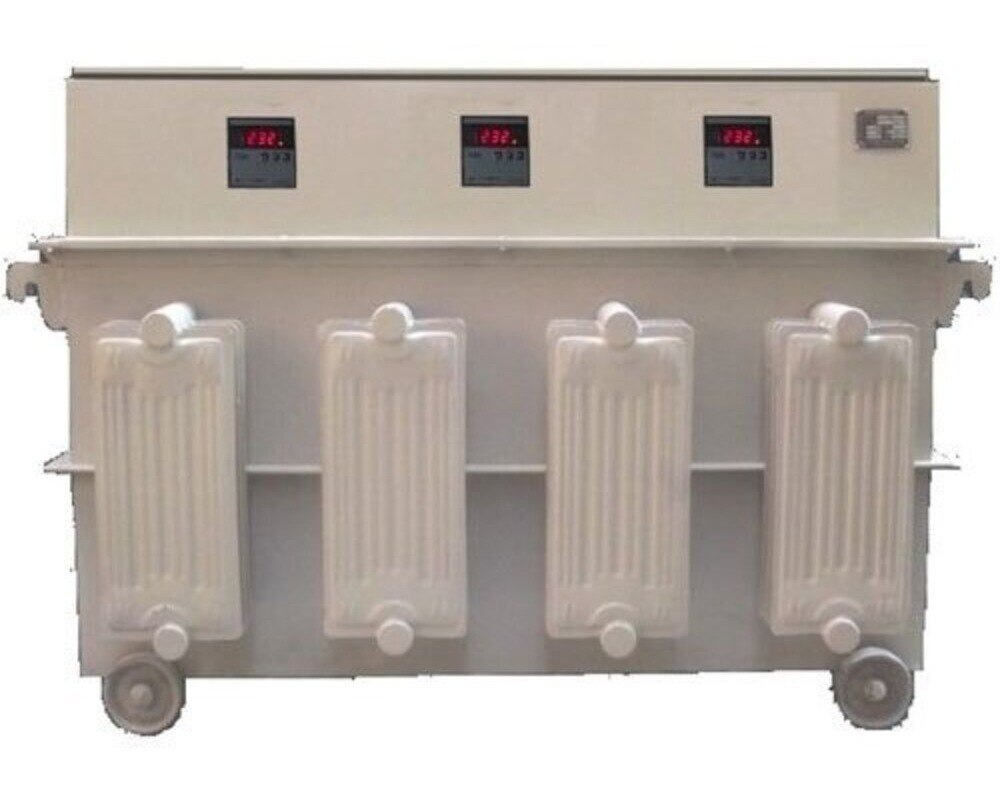
 | Varaic Type Servo Stabilizer Our Varaic Type Servo Stabilizer equipped with latest digital micro processors controllers, have been designed to give a constant output voltage with... View product → |
Frequently asked questions
How do you choose a voltage stabilizer for a commercial facility?
Identify the incoming disturbance and the loads requiring protection, then compare servo, static, relay, AVR, isolation transformer, and UPS options against response time, correction range, waveform needs, and operating conditions.
How do you size a commercial voltage stabilizer?
Calculate the connected load in kVA, include motor and compressor starting current, account for power factor, and reserve capacity for planned expansion.
What specifications should you request from a voltage stabilizer supplier?
Request the input voltage range, output regulation accuracy, response time, overload rating, efficiency, waveform impact, protection functions, and test documentation.
What installation and support details should you compare between suppliers?
Compare installation requirements, manual or automatic bypass, maintenance access, service intervals, spare-parts availability, commissioning tests, and local technical support.